Balancy gives you the controls.
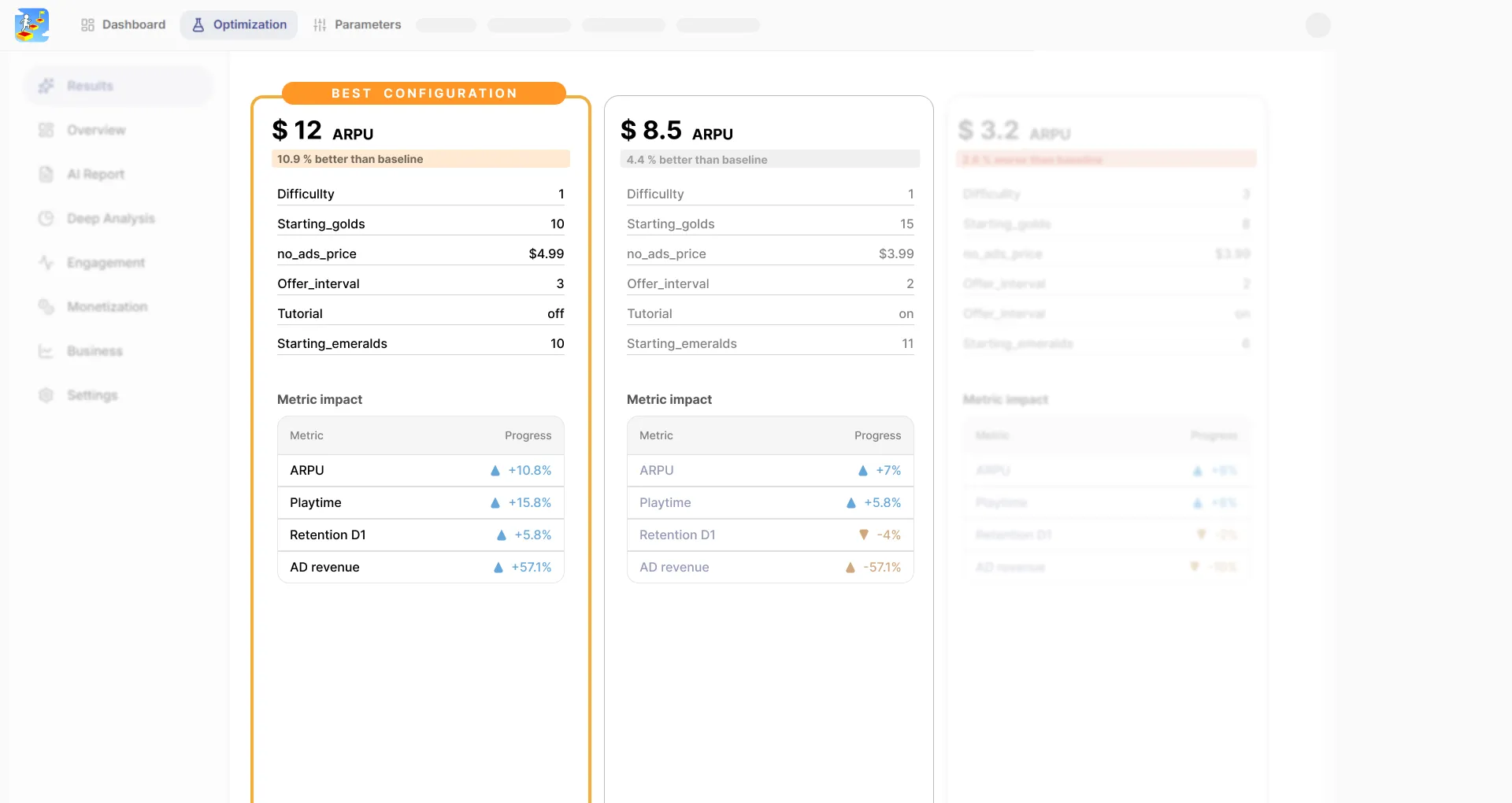
Hyperstone gives you the pilot.
- Autonomous Growth. Let the algorithm fly. Your team keeps building.
- Safety first. Set guardrails. The algorithm explores inside them.
- Multi-parameter at once. Optimise prices, rewards, and difficulty simultaneously.
Get started - it's FREE!
Free forever
No credit card required
No credit card required
Hyperstone vs. Balancy
Stop building dashboards. Start growing revenue on autopilot.
Balancy
-
Visual CMS for crafting offers and events
-
Scenario scripting without engineering
-
Manual A/B testing setup for each variant
-
LiveOps calendar for scheduling
-
Tuning still depends on designer intuition
Hyperstone
-
Autonomous multi-parameter optimization
-
Continuous exploration across player segments
-
Real-time economy balancing, no waiting
-
Bayesian algorithms that learn from small data
-
Set boundaries once, algorithm runs forever
Comparison FAQ
Balancy is a fantastic CMS for LiveOps. You build events, craft offers, launch scenarios, all in a visual editor. It gives designers full control. Hyperstone sits on a different layer. Instead of helping you launch content, it optimises the numbers inside that content. Think of Balancy as the stage director and Hyperstone as the lighting engineer who adjusts every bulb for the best look.
Absolutely. Balancy handles your content structure and visual scenarios. Hyperstone plugs into the raw parameters behind them, like reward amounts or item prices, and optimises those for revenue and retention. You get creative control plus algorithmic precision.
We focus on the optimisation layer, not content management. Designers set safe boundaries for each parameter in the Console, and the algorithm finds the sweet spot within those bounds. If you already love your CMS, Hyperstone sits on top of it.
Completely. Hyperstone explores changes gradually. If a variant underperforms, traffic swings back to the baseline automatically. You set the guardrails, the algorithm stays inside them.
On Jump Odyssey we saw ARPU go from $0.015 to $0.035. Ad impressions per user jumped from 0.3 to 2.3. Engagement time more than doubled. F2P conversion tripled from 1% to 3%. All without adding new content or changing the design vision.
 LinkedIn
 Telegram
 Email
Email