
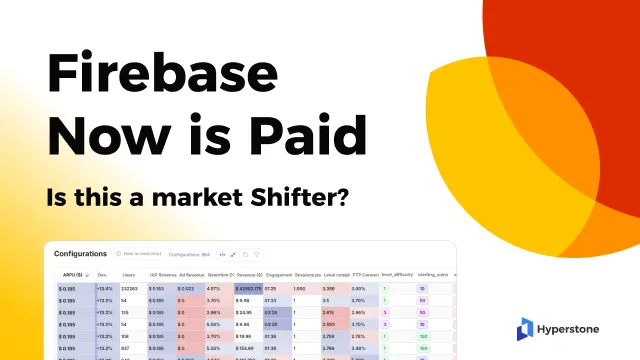
Starting September 1, 2026, Firebase Remote Config will transition to a Pay-As-You-Go pricing model. For years developers used Remote Config to tweak game parameters without pushing new builds. Now that comes with a price tag.
What Happened: The Facts
New pricing structure (per project, daily):
- Spark plan (free): Up to 100,000 fetch requests per day
- Blaze plan (pay-as-you-go): First 100,000 free, then $0.06 per 10,000 requests up to 10 million, then $0.01 per 10,000 beyond that
All advanced features (Personalization, Rollouts, A/B Testing) remain included on both plans.
Grace period: The first time a project exceeds the free tier, Firebase grants a 30-day grace period. After that, requests over the limit are throttled.
What counts as a fetch: Any client or backend call to check for updated parameters. Realtime connections don’t generate continuous requests, but the config download after a server-pushed invalidation does count. Reading cached values locally does not.
100,000 Fetches — How Many Users Is That?
Firebase default minimum fetch interval is 12 hours, so each device fetches at most twice per day.
- Default interval (12h): 2 fetches per device per day, free cap at 50,000 DAU
- Session start fetch: 1-3 fetches per device per day, free cap at 33,000-100,000 DAU
- Heavy polling (every 15 min): 96 fetches per device per day, free cap at 1,041 DAU
With default interval you need 50,000 DAU before paying anything. Most indie games won’t hit that. Mid-core titles with 100k+ installs might.
Quick Cost Estimate for Your Project
Take your DAU and estimate fetch frequency.
50,000 DAU, 1 fetch per session: 50,000 fetches/day, within free tier. $0/month.
200,000 DAU, 2 fetches per day: 400,000 fetches/day. 300,000 above free tier. At $0.06/10K that is $1.80/day or $54/month.
1,000,000 DAU, 2 fetches per day: 2,000,000 fetches/day. 1,900,000 above free tier. At $0.06/10K that is $11.40/day or $342/month.
10,000,000 DAU, 2 fetches per day: 20,000,000 fetches/day. 10,000,000 at $0.06/10K and 10,000,000 at $0.01/10K. $70/day or $2,100/month.
For most mid projects the cost is small. But it is a recurring cost for something that was free.
Migration Time
If you already use Firebase, adding an alternative SDK or replacing it takes about 30 minutes. The API is similar: fetch params, apply values for 0.5 sec.
If you don’t use Firebase and were considering it, integration time depends on project size. Indie games and mobile projects take days. Mid-core projects with complex config logic can take up to a month. Most teams considering Remote Config already have Firebase in their stack.
Our Take
Marginal cost changes behavior
100,000 daily fetches seems generous. For a small indie project with few thousand DAU the change is invisible. But as a game scales, the psychology shifts.
When every extra fetch has a marginal cost, teams start rationing. You stop experimenting with frequent config updates. You hesitate to roll out a daily change because it will cost more. You optimize for the bill, not the player experience.
Basic remote configuration (the ability to change a value in your live game without a store update) is fundamental infrastructure. It should not be a cost center.
Infrastructure vs. intelligence
We provide remote configuration for free. The value is not in delivering a variable. It is in optimizing that variable. That is where we monetize: algorithmic tuning that moves KPIs.
Market signal
This will not kill Firebase. For the largest studios these costs are small. But for indie and mid teams it is a clear signal.
Studios increasingly want transparent pricing for core infrastructure. Firebase move to PAYG for Remote Config accelerates the trend of developers diversifying their stacks.
Source: Firebase Remote Config Pricing
Firebase is a trademark of Google LLC. This article is an independent analysis and is not affiliated with, endorsed, or sponsored by Google. Pricing information is based on official Google documentation and is subject to change. Verify current pricing at the source link above.
 LinkedIn
 Telegram
 Email
Email